The Buyer‘s Checklist: What to Verify Before Ordering Food Grade Magnetic Separators & Industrial Magnetic Separators
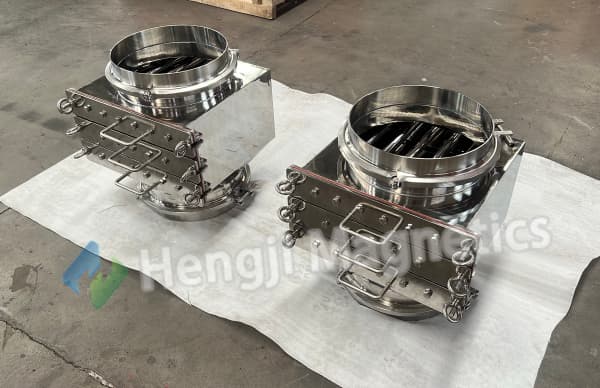
Purchasing magnetic separation equipment for food, pharmaceutical, or sensitive industrial applications is never a routine transaction. It is a critical investment in product safety, brand integrity, and regulatory compliance. A single overlooked specification can lead to contaminated product, failed audits, or costly recalls. Whether you require a hygienic food grade magnetic separators for dairy powders or a heavy-duty industrial magnetic separator for bulk minerals, success lies in the details. This guide provides a systematic, five-part checklist to ensure your equipment meets every essential requirement—from material traceability to verified magnetic performance.
Part 1: Process & Material Parameters – The Foundation of Correct Sizing
Material Characteristics to Define:
-
Physical Form: Is your product a dry powder, granule, liquid slurry, or pneumatically conveyed material? This determines whether you need a grate, drum, plate, or pipeline-style food grade magnetic separators.
-
Particle Size Distribution: Provide D10, D50, and D90 values. Finer particles require higher magnetic gradients and closer rod spacing.
-
Bulk Density & Flowability: Impacts whether the product flows freely or requires vibration or rotating magnet assemblies to prevent bridging.
-
Temperature: Standard Neodymium magnets are rated to 80°C. High-temperature variants are required above this limit.
Process Requirements to Specify:
-
Throughput Capacity: Define your required flow rate in kg/hr or m³/hr.
-
Connection Type: Flange standards (ISO, DIN, ANSI), Tri-Clamp, or threaded connections must be specified upfront.
-
Operating Pressure: Pneumatic lines may require pressure ratings up to ±1 bar.
-
Cleaning Method: Do you need rapid-disconnect drawer magnets, pneumatic rod retraction, or rotating self-cleaning systems?


Part 2: Magnetic Performance – Beyond the Surface Gauss Number
Critical Performance Specs:
-
Magnetic Strength at Working Distance: Request Gauss readings measured at the distance where your product actually contacts the magnet—typically 5mm to 12mm from the surface. A 12,000 Gauss magnet core may deliver only 5,000 Gauss at 10mm depth.
-
Target Contaminant Size: For food safety, food grade magnetic separators should reliably capture ferrous fragments and work-hardened stainless steel particles down to 50 microns. High-risk applications require 12,000+ Gauss systems.
-
Magnet Grade Verification: Premium industrial magnetic separator manufacturers test each Neodymium batch via hysterograph to confirm N35 or N45 grade compliance before assembly.
Industry Benchmark Gauss Requirements:


Part 3: Materials, Surface Finish & Hygienic Design – The Food Safety Core
Material Requirements:
-
Product Contact Surfaces: 316L stainless steel is the preferred standard for corrosion resistance and cleanability. 304 stainless is available but less suitable for acidic or high-chloride environments.
-
Material Traceability: Demand a Mill Test Certificate verifying 316L grade and compliance with FDA 21 CFR 177.2600 for food contact.
Surface Finish & Fabrication:
-
Roughness (Ra): Standard food grade magnetic separators require mechanical polish to 0.8 micrometres or less. For wet or high-hygiene applications, specify electropolishing, which removes the microscopically rough surface layer, enhancing corrosion resistance and cleanability.
-
Welds: All interior seams must be fully welded and ground smooth to zero crevice. No bolt-on liners or spot welds are acceptable in sanitary construction.
Seals & Gaskets – The Hidden Risk:
Part 4: Compliance, Certification & Documentation – Your Audit Trail
Essential Certifications:
-
FDA 21 CFR: All food-contact materials must comply.
-
EU 1935/2004 & 10/2011: Required for European market equipment.
-
3-A Sanitary Standard: The gold standard for dairy and liquid food applications. Only premium food grade magnetic separators carry this certification.
-
CE & UL: Regional safety certifications for electrical components.

Required Documentation Package:
-
Material Test Certificates for all wetted alloys.
-
Surface finish inspection report verifying Ra value.
-
Gauss mapping report showing field uniformity across the working face.
-
FDA/EU compliance declarations for polymers and elastomers.
-
Certificate of conformance and clean-and-sealed packaging declaration.
Manufacturer Qualification:
Part 5: Lifecycle Support – Maintenance, Validation & End-of-Life
Validation & Testing:
-
Factory Acceptance Testing: Witness magnetic performance and pressure testing before shipment.
-
Site Acceptance Testing: Define acceptance criteria for on-site commissioning. Target removal efficiency should exceed 99.5% for specified contaminant sizes.
Maintenance Planning:
-
Magnet Lifespan: High-quality food grade magnetic separators retain more than 90% magnetic strength for 8 to 10 years under normal conditions. Request expected annual flux loss data.
-
Spare Parts: Specify an initial kit including all seal sizes and any specialized cleaning tools.
-
Re-certification: Schedule third-party Gauss verification every 12 to 24 months to maintain HACCP validation.
Responsible Disposal:

Conclusion: Precision Specification Prevents Costly Failures
The True Value of Quality: Why Permanent Drum Magnets Outperform Cheap Imitations Over Their Lifecycle
Troubleshooting Your Permanent Magnetic Drum: Fixing Belt Misalignment, Carryover & Poor Separation
Related Article