The Battery-Grade Purity Barrier: How an Electromagnetic Wet Magnetic Separator Achieves PPB-Level Iron Control
In the world of lithium battery materials, purity is not just a specification—it is a safety and performance mandate. For battery-grade lithium carbonate, the acceptable level of iron contamination is measured in parts per billion. This is the equivalent of a few grams of iron in ten tons of material. Achieving this extreme purity pushes conventional filtration and chemical methods to their limits. The technology that consistently crosses this threshold is the electromagnetic separator configured as a precision wet magnetic separator. This article reveals how these systems execute a magnetic "siege" against ultra-fine, weakly magnetic iron particles.

Why PPB-Level Iron Control is So Difficult
-
Sub-Micron Oxides and Hydroxides: Particles of Fe₂O₃, Fe(OH)₃, and similar compounds, often colloidal in size.
-
Surface Adsorbed Films: Iron compounds adhering to the surface of lithium carbonate crystals.
-
Extremely Weak Magnetic Susceptibility: These iron compounds are weakly magnetic, requiring far more magnetic force than standard permanent magnets can provide.
The Breaking Point: Three Core Design Features of an Electromagnetic Wet Magnetic Separator
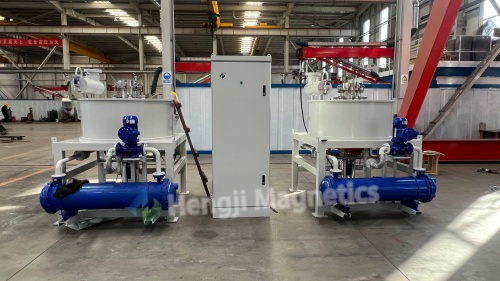
1. Ultra-High, Adjustable Magnetic Field: The Electromagnetic Coil
-
Unlike fixed permanent magnets, an electromagnetic separator generates a background field that can exceed 20,000 Gauss (2 Tesla). This provides the fundamental magnetic "potential" required to attract weakly susceptible particles.
-
Field strength is continuously adjustable. Operators can match the magnetic force precisely to the feed material's iron content, optimizing both removal efficiency and energy consumption.


2. High-Gradient Magnetic Matrix: Creating Capture Traps
-
When magnetized, the sharp edges and fine filaments of this matrix create intensely localized magnetic gradients—areas where field strength changes dramatically over microscopic distances.
-
As lithium carbonate slurry flows through this matrix, even sub-micron iron particles experience a powerful gradient force that pins them to the matrix surface. The effect is like deploying millions of microscopic magnetic hooks throughout the flow path, rather than a simple net.
3. Precision Flow Path and Automatic Cleaning: Ensuring Consistent Output
-
Optimized Flow Design: Slurry passes through the matrix in thin, controlled layers, ensuring every microliter contacts the magnetic traps. This eliminates short-circuiting where untreated material could slip through.
-
Fully Automatic Online Cleaning: This is the key to uninterrupted, ppb-level production. The cycle is simple:
-
Capture Mode: The electromagnet is energized. Iron is trapped on the matrix.
-
Flush Mode: The magnet is de-energized or its field is reduced. A burst of high-pressure clean water back-flushes through the matrix, scouring every trapped particle into a waste stream. The magnet then re-energizes instantly for the next cycle.
-
-
The entire process occurs without stopping the main production flow, eliminating the contamination risk and yield loss associated with manual cleaning.
The Practical Process: Achieving PPB Levels in Production
-
Chemical Pre-Treatment: Remove the bulk of heavy metals through conventional means to reduce the load on the magnetic system.
-
Precision Filtration: Eliminate larger particles that could clog the delicate magnetic matrix.
-
Slurry Optimization: Control concentration, pH, and dispersant addition to ensure iron particles are fully dispersed and presented individually to the magnetic field.
A single electromagnetic separator pass rarely achieves ppb levels from ppm-level feed. The standard is a two or three-stage series circuit:
-
Rougher Stage: Higher field strength, higher flow. Removes 90%+ of the iron.
-
Cleaner/Polisher Stages: Optimized field and flow specifically target the most difficult residual ultra-fine particles, driving iron content down to the single-digit ppb range.
Advanced systems integrate online analyzers (e.g., ICP-OES) to monitor effluent iron content in real time. This data automatically adjusts field strength, flow rate, and flush frequency, creating an intelligent, self-optimizing wet magnetic separator circuit.

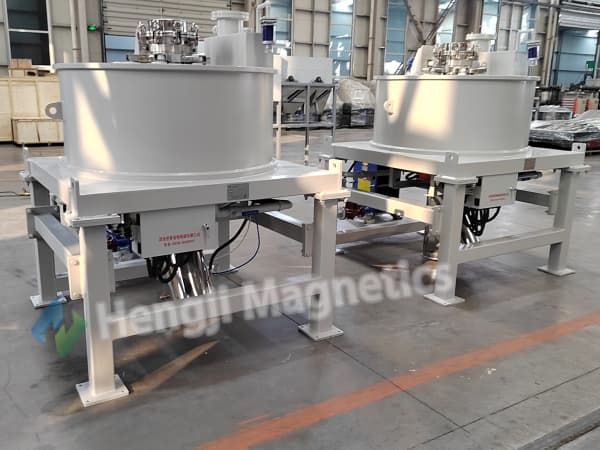
Conclusion: From Chemical Process to Precision Physical Purification
-
Extreme magnetic force from powerful coils.
-
Extreme magnetic gradient from engineered matrices.
-
Extreme process stability from automated, in-situ cleaning.
The Sub-100 Micron Battlefield: How Rare Earth Roll Magnetic Separators Conquer Fine Particle Separation
The Unsung Hero of EV Batteries: How Magnetic Roller Separators Enable High-Purity Materials
Related Article