The Unsung Hero of EV Batteries: How Magnetic Roller Separators Enable High-Purity Materials
2026-03-16
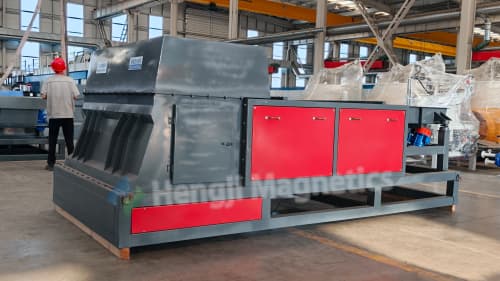
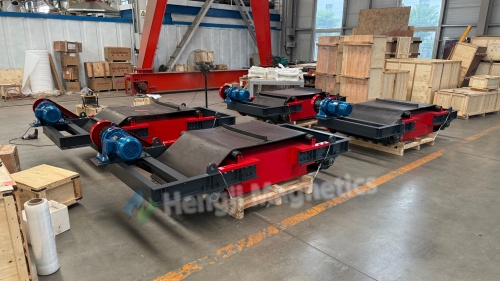
In the high-stakes world of lithium-ion battery manufacturing, purity is not just a quality metric—it is a matter of safety. A single microscopic particle of iron, nickel, or chromium contaminating a batch of cathode material can trigger internal shorts, thermal runaway, and catastrophic battery failure. The industry's response to this risk is a rigorous standard: magnetic foreign material content must be measured in parts per billion. Achieving this level of purity demands the most advanced physical separation technology available. A high intensity magnetic separator configured as a precision magnetic roller separator has become the silent guardian of battery quality, working upstream to eliminate magnetic contaminants before they can ever reach a cell.

The Mission: Stopping Magnetic Foreign Material at the Source
Magnetic foreign material—particles of iron, steel, nickel, chromium, and their alloys—are the most dangerous contaminants in battery materials. They enter the process from equipment wear, raw material impurities, or handling. In a finished battery, these hard, conductive particles can pierce the separator membrane, creating a direct short circuit. This is a primary cause of thermal runaway, fire, and explosion in lithium-ion cells.
The specification for premium cathode and anode materials is unforgiving: total magnetic foreign material content must be below 10 parts per billion. This is the equivalent of one gram of contamination in 100 tons of material. Only a high intensity magnetic separator engineered for extreme duty can consistently meet this standard.
Application 1: Purifying Cathode Precursors
The journey begins with precursor materials for NCM, NCA, and LFP cathodes. After co-precipitation synthesis, the material is vulnerable to contamination from pumps, pipes, and agitators.
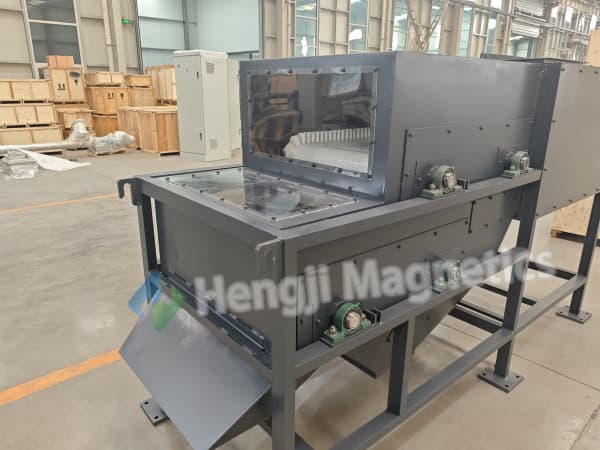
A magnetic roller separator processes the precursor slurry or dried powder with intense magnetic fields, capturing micron-scale wear debris before it can be incorporated into the final material. This ensures that when the precursor enters the high-temperature sintering furnace, it is free from impurities that could diffuse and compromise the entire batch.
Application 2: Polishing Anode Materials
Graphite, whether natural or synthetic, presents a unique challenge. While graphite itself is diamagnetic (slightly repelled by magnets), the mechanical processes used to spheronize and coat it generate significant iron contamination. Silicon-based anodes, critical for next-generation energy density, face similar purity demands.
A dry high intensity magnetic separator with multiple passes and precisely controlled fields removes metallic particles while allowing the valuable anode material to pass through efficiently. This achieves the required purity without sacrificing yield.

Application 3: Refining Lithium Salts
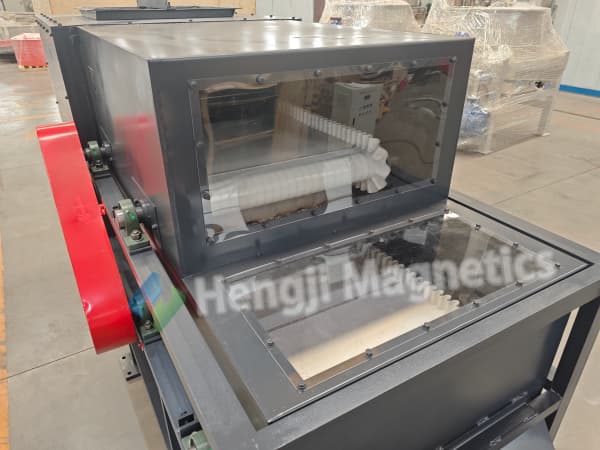
Battery-grade lithium carbonate and lithium hydroxide must exceed 99.5% purity. After chemical refining and crystallization, a final magnetic polishing step on a magnetic roller separator removes any trace metals introduced from equipment or the environment, guaranteeing that the lithium salt meets the stringent requirements of electrolyte and cathode manufacturers.
Application 4: Cleaning Recycled "Black Mass"
As battery recycling becomes essential to the circular economy, the high intensity magnetic separator plays a critical role. Shredded batteries produce "black mass"—a mixture of cathode and anode materials contaminated with steel casing fragments, copper tabs, and other metals.
Before hydrometallurgical recovery, a magnetic roller separator rapidly removes the strongly magnetic steel and iron components. This protects downstream leaching equipment, reduces acid consumption, and prevents contamination of the valuable cobalt, nickel, and lithium solutions, improving both recovery efficiency and final product quality.
Engineered for the Battery Industry: Specialized Features
A standard magnetic separator is not sufficient for lithium-ion applications. The magnetic roller separator used in this field is a precision instrument with specific characteristics:
-
Totally Non-Magnetic Construction: All contact surfaces—chutes, liners, belts, fasteners—are 304/316L stainless steel, ceramic, or engineered polymer. This prevents the equipment itself from becoming a source of contamination.
-
Extreme Field Strength and Gradient: High-grade Neodymium or Samarium Cobalt magnets are arrayed in optimized multi-pole circuits, generating surface fields exceeding 12,000 Gauss. Many units incorporate stainless steel wool or mesh matrices to create intense magnetic gradients capable of capturing sub-micron particles.
-
Clean-Room Compatible Design: Units are fully sealed and dust-tight, suitable for integration into controlled environments. They can be connected to plant DCS/MES systems for real-time monitoring and data logging.
-
Multi-Pass Configurations: To achieve parts-per-billion purity, a single pass is rarely enough. Systems often employ two or three high intensity magnetic separator stages in series, arranged as a "rougher-cleaner-scavenger" circuit.

Conclusion: The Hidden Enabler of Battery Technology
As the industry moves toward solid-state batteries, ultra-high-nickel cathodes, and silicon-dominant anodes, the purity requirements will only become more demanding. The magnetic roller separator will remain an essential tool, operating quietly upstream to deliver the pristine materials that next-generation batteries require. It is not the most glamorous piece of equipment in a battery plant, but it may be the most important. In the quest for safer, more powerful, and longer-lasting batteries, the high intensity magnetic separator is the unseen foundation upon which progress is built.
The Battery-Grade Purity Barrier: How an Electromagnetic Wet Magnetic Separator Achieves PPB-Level Iron Control
Media Clogged? How to Correctly Set the Backwash System on Your Dry High Gradient Magnetic Separator
Related Article
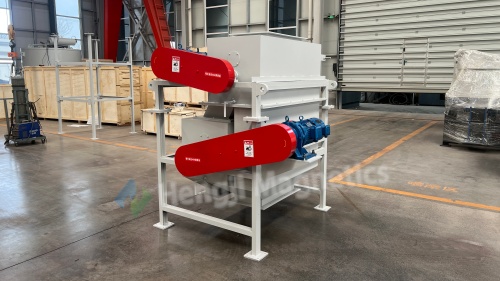
Rare earth dry drum magnetic separator combines rare earth magnetic force with dry processing to remove fine iron from powders, with no demagnetization and low energy use.
Rare Earth Dry Drum Magnetic Separator: Rare Earth-Level Magnetic Force for Dry Processing
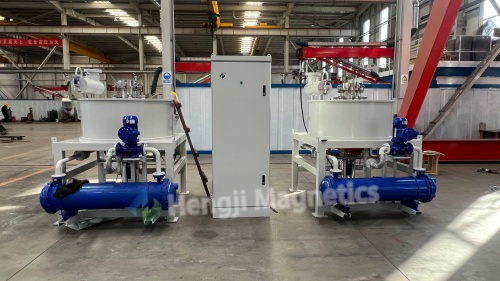
Dry electromagnetic food grade magnetic separators ensure safe, thorough iron removal from food powders with hygienic stainless steel construction and oil-cooled electromagnetic coils.
Food Grade Magnetic Separators and Dry Electromagnetic Separator: Ensuring Safe and Thorough Iron Removal in Food Powders