How Much Magnetic Strength Remains After Five Years? Field Testing Your Drum Magnetic Separator
Time and trust. You've relied on your drum magnetic separator for five years, watching it process millions of tons, protect downstream equipment, and deliver consistent product quality. But beneath that stainless steel shell, the invisible force that makes it all possible—the magnetic field—may be slowly fading. The question every operator eventually asks: how much magnetic strength does my permanent wet magnetic separator actually have left? The answer determines whether you can confidently run another five years or if a magnetic upgrade is already overdue. This guide provides simple, practical field methods to find out.
Part One: The Theory – What Five Years Does to Magnets
Under ideal conditions (temperature consistently below 80°C, no chemical corrosion, minimal vibration), modern Rare Earth magnets in a quality drum magnetic separator lose less than 1% of their strength per year. After five years, you can expect more than 95% of the original magnetic force to remain.
Older or economy-grade magnets are less stable. In demanding wet processing environments, annual decay can reach 3-5%. After five years, a permanent wet magnetic separator with ferrite magnets might retain only 80-85% of its initial field strength.
These are theoretical best-case numbers. Real-world factors like water ingress through failed seals, abrasive slurry erosion, overheating events, or mechanical shock can accelerate decay dramatically. This is why field testing is essential—you cannot assume performance based on age alone.

Part Two: The Three-Step Field Test – No Disassembly Required
Step One: Visual and Tactile Check
-
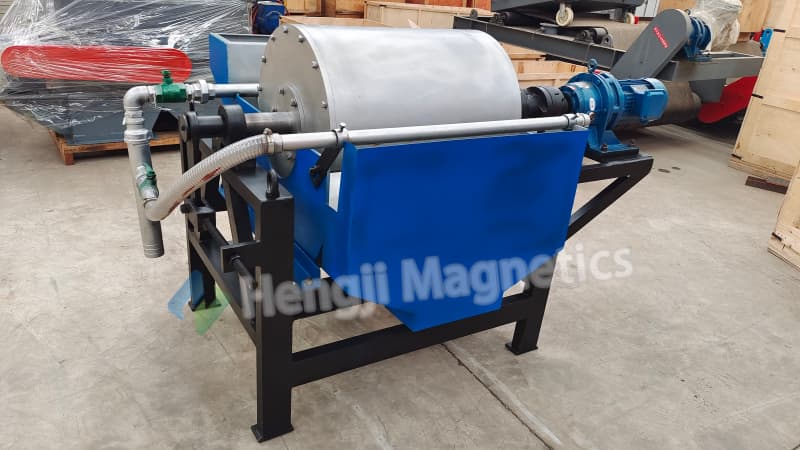
The Screwdriver Test: With the permanent wet magnetic separator completely stopped and cleaned, hold a small steel tool like a screwdriver or wrench near the drum surface. A healthy magnet should grab it firmly from 1-2 centimeters away. If you must touch the drum to feel attraction, or if the tool falls off easily, magnetic strength is compromised.
-
Check Your Production Data: Review recent assay results. If concentrate grade is dropping or you see visible magnetic minerals reporting to tailings ("runaway tailings"), magnetic weakness is a likely culprit.

Step Two: Quantitative Testing with a Gauss Meter
This is the most accurate field method for your drum magnetic separator.
What You Need: A handheld Gauss meter (Tesla meter) with a range covering your magnet's rated strength.
Preparation: Ensure the permanent wet magnetic separator is locked out and the drum surface is clean and dry.
Measurement:
-
Hold the probe perpendicular to and touching the drum surface.
-
Take readings at multiple points along the drum length and circumference, especially at the feed zone, separation zone, and discharge area.
-
Record the peak values at each location.
Analysis: -
Compare your readings to the original factory specifications or commissioning records.
-
If measured values are below 90% of the original, significant decay has occurred.
-
If readings vary by more than 15% across the drum face, individual magnets may be damaged or missing.
If you don't have a Gauss meter, this practical method still provides useful data.
-
Find a clean steel block of known weight (e.g., 50 grams).
-
Place it on the drum surface at a consistent location and gradually increase the distance until it falls. Measure that distance.
-
Compare this "hold distance" to records from when the drum magnetic separator was new or known to be healthy. A significantly shorter distance means weaker magnets.
-
Run the permanent wet magnetic separator at normal feed density, then briefly stop the feed (safely).
-
Observe the layer of magnetic concentrate coating the drum. An uneven, patchy, or unusually thin coating is a strong indicator of field weakness or magnetic circuit damage.
Part Three: What Your Results Mean – Action Guide
Your drum magnetic separator is in excellent health. Continue normal operation and scheduled maintenance. Perform this test annually to track any changes.
Magnetic decay is occurring. Closely monitor separation performance—concentrate grade and recovery. Begin planning for a magnetic circuit inspection and potential upgrade within the next 12-24 months.
Magnetic loss is severe and is almost certainly hurting your metallurgical performance and profitability. Plan for an immediate professional inspection and magnetic system replacement. The cost of lost product likely already exceeds the upgrade investment.

Part Four: When to Call the Professionals
-
Open the sealed drum to inspect magnets for cracking, corrosion, or detachment.
-
Check seal integrity for evidence of water or slurry ingress.
-
Assess the feasibility and ROI of upgrading to higher-grade Neodymium magnets during the rebuild.
Conclusion: Knowledge is Control
Aluminum Cans, Copper Wire, Circuit Boards: How Eddy Current Magnetic Separators Extract Value from Waste
What Does One Hour of Downtime Cost? A Spare Parts Strategy for Your High Gradient Plate Magnetic Separator
Related Article